


Risshodo Co., Ltd.
Extending Shelf Life to Bring Junmai Senbei to the World
Recently, Yasuhiro Tsunokake, one of our Overseas Business Coordinator, paid a visit to Risshodo Co., Ltd.—a local rice cracker manufacturer—to speak with its CEO, Genichiro Machida.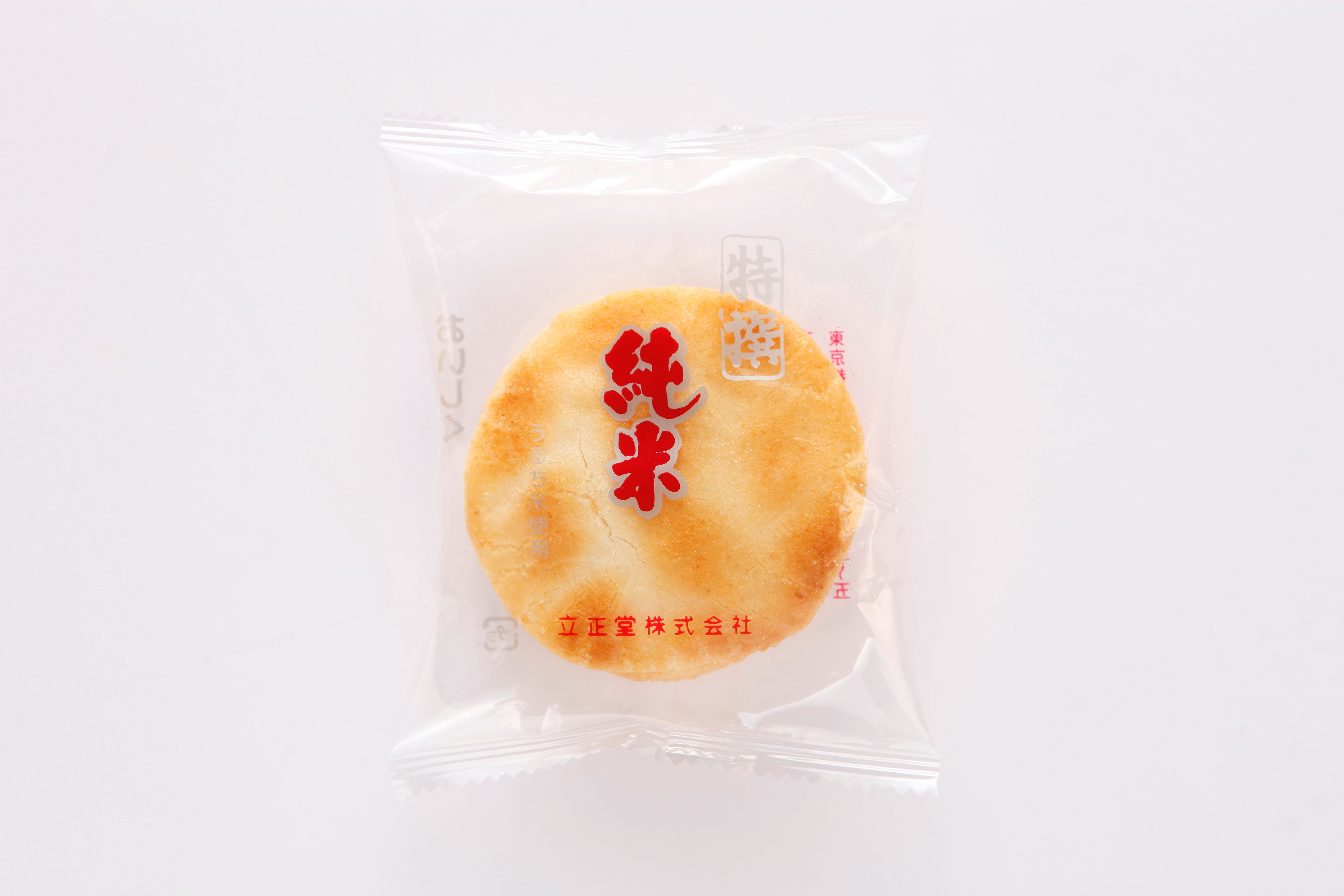
Business Overview
Tsunokake:To start, could you tell us a bit about your business?
【Flagship Product:"Junmai Senbei"】
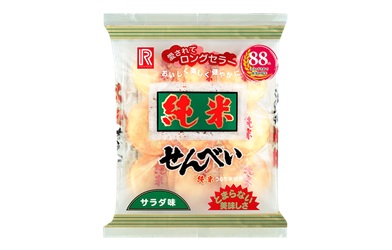
Machida:Certainly. Founded in 1935, we specialize in manufacturing rice crackers. Using carefully selected rice, we handle the entire production process in-house at our own factory—from rice polishing and dough making to baking, seasoning, and packaging. Our flagship product, "Junmai Senbei," has been a customer favorite and long-time bestseller for over 50 years.
Tsunokake:I'm actually a huge fan of that wonderfully crunchy texture! It really shows how in-house production makes all the difference. I’ve also noticed your company featured in the media recently.
Machida:Thanks to that media coverage, we've seen a growing number of inquiries about Junmai Senbei. In fact, according to Nikkei POS sales data, it has been recognized as the top-selling rice cracker in our region for seven consecutive years, from 2019 to 2025.
Exporting and Overseas Expansion
Tsunokake:With your domestic sales going so well, what inspired you to start exporting your products overseas?
Machida:Our decision to venture into international markets stemmed from a sense of urgency. With Japan’s shrinking population, we felt that significant domestic growth would be difficult in the long run. At the same time, we noticed a growing global demand for Japanese food and we can see a lot of energy in the market. We realized that exporting could allow us to sell our products at higher value and price points, and that was the spark.
Tsunokake:You saw clear potential in taking your products abroad. When you actually began preparing for export, what challenges did you face?
Machida:Shelf life turned out to be our biggest hurdle. For the domestic market, our Junmai Senbei had a shelf life of 120 days from the date of packaging. While that works well enough in Japan, exporting overseas requires accounting for ocean freight shipping, customs clearance, local warehousing, and the time it takes to reach retail shelves. With all those factors, 120 days left is too short a selling window in local markets, making it a difficult product for overseas buyers and trading companies to handle.
Tsunokake:What steps did you take to extend the shelf life for export?
【Baking: The Key to Creating Our Signature Texture】
Machida:We started by looking into modified atmosphere packaging (MAP)*. Moisture is the ultimate enemy when it comes to preserving the signature crunch of Junmai Senbei, so we explored ways to adjust the air inside the packaging to keep humidity at bay.
*(MAP: A packaging technique that preserves product quality by replacing the air inside the package with specific gases.)
Tsunokake:So keeping moisture out was the key to preserving that signature crunch while extending the shelf life. Did you consider any other solutions?
Machida:We also upgraded our packaging materials. After testing various options, we found that aluminum film offered the highest level of moisture protection, so we decided to switch to aluminum packaging for export products only. In addition, to further combat humidity, we experimented with different sizes of desiccants and tested silica gel packets.
Tsunokake:That shows incredible dedication—testing, reviewing results, and making continuous improvements step by step.
Machida:Absolutely. On top of that, while our domestic products are packaged with two rice crackers per individual pouch, we adjusted the export version to pack them individually, one per pouch. After about five years of persistent effort, we successfully extended the shelf life of Junmai Senbei from 120 days to 300 days.
Tsunokake:Extending the shelf life that much through trial and error is truly impressive. Were there any other changes you made to tailor the product for export?
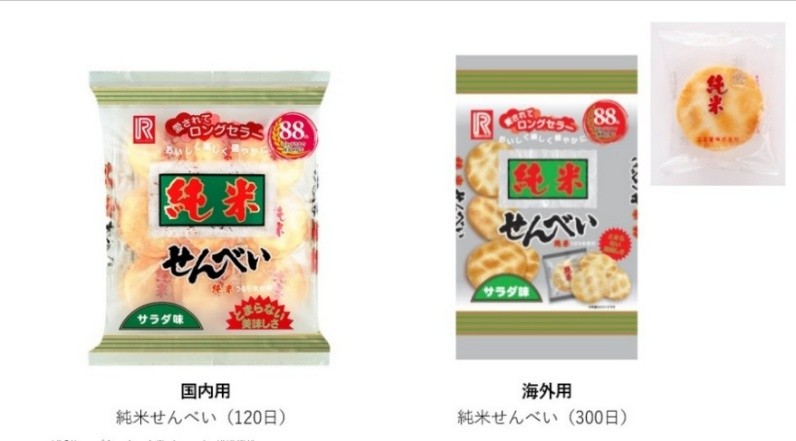
【Package Comparison: Domestic vs. Export 】
Machida:Initially, our export packaging didn't include any illustrations or photos of the rice crackers. However, trading company buyers pointed out that products are harder to sell when customers cannot see what`s inside. They suggested to add photos or illustrations showing the contents so that customers will be more interested in picking up the products. That led us to create our current export packaging, which prominently features a photo of the rice cracker.
Tsunokake:You really embraced every improvement with an open mind. Did extending the shelf life to 300 days bring about noticeable changes?
Machida:It made a huge difference—our product became much easier to pitch to overseas buyers and trading companies. Even after factoring in transit time and local distribution, having ample selling time on retail shelves is a major advantage.
Tsunokake:How is your export business performing today?
Machida:We’ve seen a steady increase in both inquiries and actual export shipments across various regions, including the U.S., Europe (Spain, the Netherlands, France, the UK, and Switzerland), the UAE, Australia, New Zealand, and Hong Kong. It brings us immense joy to see Junmai Senbei, a long-time favorite here in Japan, now reaching and being enjoyed by customers around the world.
Previous articles Back to list Next articles